Lopsided, Slightly Burned, Deeply Loved: The Psychology of the DIY Keyboard
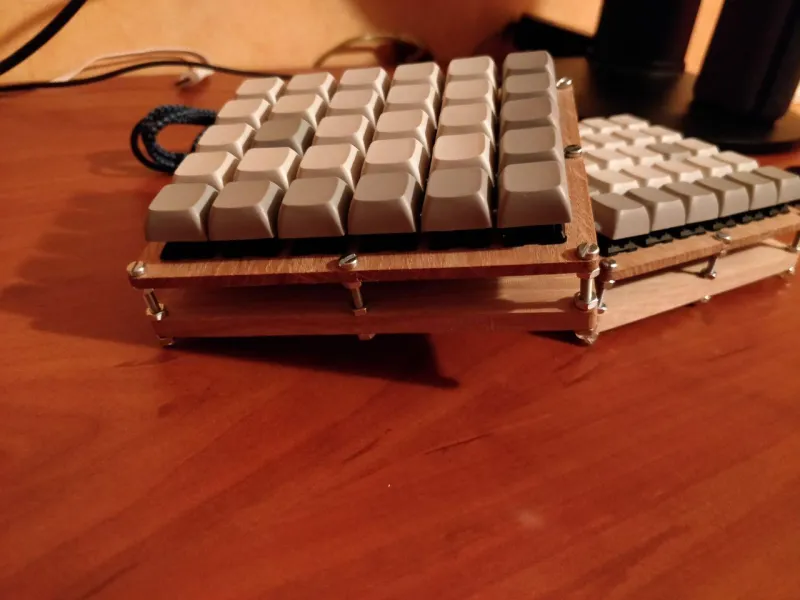
Photo: handmade split mechanical keyboard plywood case soldering workbench, via i.redd.it
There's a keyboard hanging on my wall that doesn't work. It has a hand-soldered controller, a case printed on a friend's Ender 3, and a top row that sits about three degrees off-axis because I eyeballed the alignment at 1 a.m. It is, objectively, worse in every measurable way than the $90 board I use at my desk.
I love it more than any keyboard I've ever owned.
If this sounds familiar, congratulations: you've been hit by the IKEA effect.
The Science of Loving What You Built
Back in 2011, Harvard's Michael Norton and Daniel Mochon, along with Duke's Dan Ariely, published a pair of studies that put a number on something every tinkerer already knew. Participants who assembled IKEA storage boxes valued them higher than identical pre-assembled boxes — and the effect survived even when the result was a mangled, wrongly-assembled mess.
The name came later, but the phenomenon is broader than flat-pack furniture. Norton's follow-up work found people would pay a premium for folding their own origami, building their own LEGO sets, even mixing their own iced coffee. The labor itself creates value. Effort justification, the psychologists call it: we don't just tolerate the cost of building something, we retroactively convert that cost into affection.
For DIY hardware people, this is basically our entire hobby described in a journal abstract.
But here's the part the research misses. The IKEA effect studies used participants assembling pre-designed kits once, under lab supervision. Keyboard builders run the loop hundreds of times — designing the plate, flashing the firmware, tuning the switches, lubing, modding, re-soldering. We're not just assembling flat-pack. We're iterating. And iteration doesn't just create attachment; it creates expertise, which creates competence, which creates even more attachment. It's a flywheel with a soldering iron in the middle.
There's also a quieter, more Finnish reason, which I'll get to.
Build Log: The Sauna Split (A Beginner-Friendly Board)
I wanted a keyboard that embodied a specific idea: the Finnish concept of kompromissiton — uncompromising — but applied to compromise itself. Minimal parts, minimal keys, maximum honesty. A split board small enough to fit on a crowded US apartment desk, cheap enough that a first-timer wouldn't cry over a fried diode.
Here's the full bill of materials, with real numbers:
- 2x Pro Micro microcontrollers — $8 (clone boards, because the real ones deserve better than my soldering)
- 42x through-hole diodes — $3
- 42x MX-compatible switches — $28 (tactile, because clicky people are brave and I am not)
- Keycaps, blank, budget set — $20
- 2x TRRS jacks and a cable — $6
- 1x sheet of 3mm birch plywood — $9 (the Finnish part of the build; also the part I'm proudest of)
- Wire, solder, flux — $10 if you're starting from zero
Total: about $84. For comparison, a prebuilt ergonomic split board runs $200–$350 in the US market. So yes, you save money — right up until you buy a second one, and a third, and suddenly you own seven boards and a switch tester, but that's a different article.
The mistakes, in chronological order:
- I wired the left half's matrix backwards. The keyboard worked perfectly except every key did something slightly wrong, like a Ouija board with opinions.
- I used QMK's default keymap for a full-size board on a 42-key layout, which meant pressing Escape summoned a small apocalypse of wrong layers.
- I sanded the plywood case with 80-grit, which gave it a texture best described as "rustic," or possibly "angry."
And here's the thing: every one of those mistakes is why I love it. The backwards matrix taught me how a matrix actually works. The default keymap forced me to learn layers properly. The angry plywood looks like something made by a human in a garage, because it is.
The Quiet Part: Enough Is Enough
Which brings me back to Finland. Finnish design culture — the Marimekko prints, the Iittala glassware, the national insistence that a chair should last forty years — is built on a respect for restraint. Things are made to be used, not upgraded. A keyboard with 42 keys and blank caps is a design decision, not a limitation: it says this is everything I need, and nothing I don't.
The IKEA effect gets framed as a cognitive bias, a glitch in our valuation software. But maybe it's also a correction. When you build your own input device, you're not being irrational about its value — you're accounting for something a spec sheet can't measure. Your knowledge of it. Your hours in it. Your three degrees of misalignment.
So build the ugly one. Burn a pad or two. Get the firmware wrong on the first flash and the fourth. The lopsided result will out-love anything you could buy, and unlike the MALM dresser, nobody at your office will ask you to help them assemble one.
Got a build log of your own, beautiful or cursed? Send it to us — the more misaligned, the better.