My Cat Has Filed a Formal Complaint: Building the Loudest Quiet Project of the Year
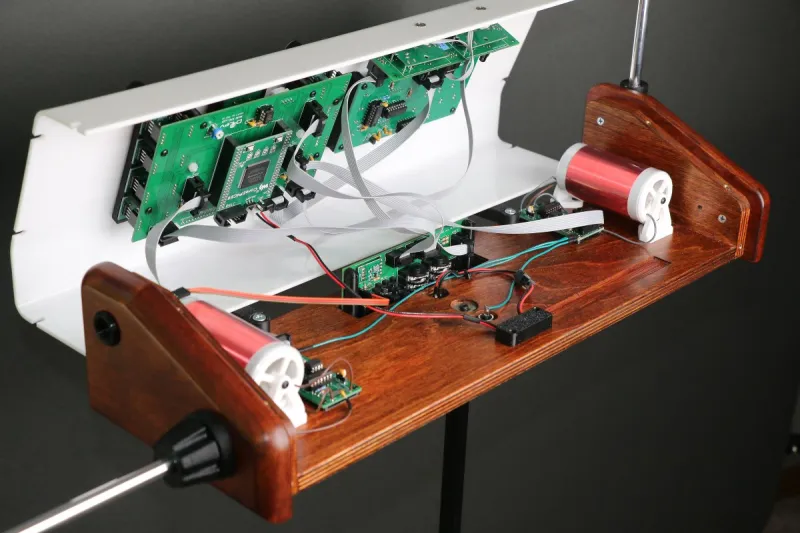
Photo: homemade theremin electronics project breadboard antenna on wooden desk, via technitoys.com
There is a category of DIY project that serves no purpose, makes no money, and improves nothing. In Finland they might call this harrastus — a hobby, pursued with the grim seriousness of a national defense initiative. I call it Tuesday night.
This week's Tuesday night project: a homemade theremin. An instrument you play without touching. A box that screams into the void when you wave your hands near it. A device my cat, Pixel, has come to regard as an act of war.
Why Build the One Instrument Nobody Can Play
Fair question. The theremin is famously the only instrument where mastery is measured in decades and mediocrity is measured in dogs barking. Leon Theremin patented it in 1928, and it went on to score every alien invasion and psychological thriller of the mid-century. It's also, quietly, the perfect first hardware project for a software person.
Here's why: a theremin is just two radio frequency oscillators, one of which shifts when your hand (a big bag of saltwater, capacitively speaking) drifts near its antenna. The beat frequency between the two oscillators is what you hear. That's it. That's the whole magic trick. If you can reason about a for loop, you can reason about a heterodyne oscillator. You just have to build it in the physical world, where electrons are less obedient than integers.
The Parts List (All American, All Available Before the Weekend)
Total damage: about $40, assuming you already own a soldering iron and a grudge.
- Two 555 timer ICs, or better, a proper oscillator module if you want to feel fancy
- One 2N3904 and one 2N3906 transistor pair for the pitch difference stage
- A handful of resistors and capacitors — the full BOM is basically a bag of assorted parts from any electronics supplier
- A 9V battery or, if you're brave, a 12V wall wart you've verified with a multimeter like a responsible adult
- One telescoping antenna (an old FM radio antenna works beautifully)
- A small metal plate for the volume antenna, because we're doing this properly
- An enclosure. Mine is a birch plywood box, because this is Finnputer and the plywood is non-negotiable
- An audio jack and any powered speaker you have lying around
The Circuit, Explained Like You're a Programmer
Think of it like this: oscillator A runs at a fixed frequency, say 200 kHz. Oscillator B also targets 200 kHz, but its frequency is coupled to the antenna, and your body's capacitance nudges it around. When you mix the two signals, what drops out is the difference between them. Zero hertz difference means silence. Three kilohertz difference means a noise that makes your cat leave the room at a brisk trot.
The tuning is done with a trimmer capacitor, which is a polite way of saying you'll turn a tiny screw seventy times muttering "there we go — no — there we go" like a person who has lost custody of their evening.
Soldering order matters less than you'd fear and grounding matters more than you'd hope. Build on a breadboard first. My first attempt worked perfectly on breadboard and then refused to work the moment it touched plywood, which I can only assume was the wood's opinion of my musicianship.
Calibration, or: Standing Very Still for Science
Here's the part nobody warns you about: once it works, you are part of the circuit. Every gesture is a note. Shift your weight, and the pitch slides. A housemate walks past, and the theremin wails like it's seen something. This is the part Pixel finds unforgivable.
I spent an evening trying to play a simple scale. What I produced was closer to a haunted doorbell. What my cat produced was a formal posture of protest from under the couch, tail flicking in a rhythm suspiciously close to 440 Hz.
A Soundtrack-Only Video (For Everyone's Safety)
We filmed a demo. There is no talking in it, because talking would have been inaudible over the theremin. Every pet within earshot of the Finnputer test kitchen has been notified. Watch it with the volume at your own risk; we accept no responsibility for departed cats or confused neighbors.
The footage reveals the honest truth of the build: it works, it's eerie, it's genuinely playable in the way that a kazoo is genuinely playable — technically, and with commitment.
What a Useless Box Teaches You About Useful Skills
Here's the crossover that makes this worth your weekend. Analog electronics is debugging without stack traces. There's no error message when your ground path is bad — there's only a theremin that hisses when you breathe. You learn to isolate variables, to distrust your assumptions, to probe signals with a multimeter the way you'd add print statements to a misbehaving function.
And unlike a firmware project, when you're done you have a physical object that makes a sound that has never existed before in the exact shape you made it. That's not nothing. That's the whole reason any of us got into this hobby in the first place.
Pixel has since negotiated a ceasefire: the theremin lives in the closet, and she lives everywhere else. That's about the ratio of triumph to compromise you should expect from any gloriously impractical build. Start soldering.