Enough Is a Design Decision: A Case for Building the Quiet PC
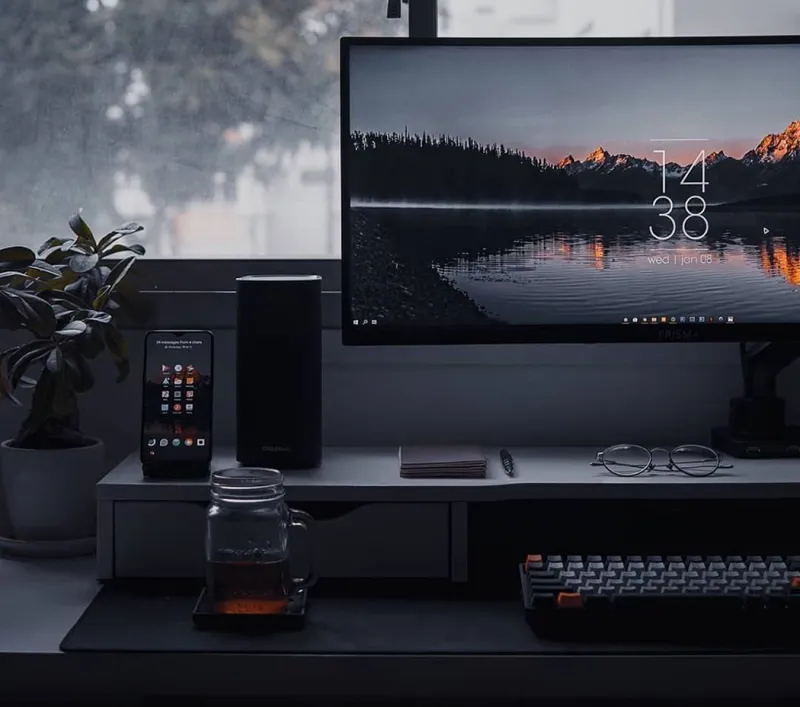
Photo: minimalist dark desk setup computer no rgb scandinavian, via www.yankodesign.com
There's a particular sound an American gaming rig makes at 2 a.m. It's not the fans—those you can tune. It's the RGB controller software spinning up, the AIO pump whirring like a tiny hydroelectric dam, and somewhere deep in the case, a fan spinning at 4,000 RPM to cool a GPU that's currently rendering your desktop wallpaper.
I've built these machines. I've been this machine. And after a decade of spec-sheet one-upmanship, I want to make the case for the other thing: the quiet, restrained, honestly-sufficient PC.
The Spec Sheet Is a Marketing Document
Here in the US, we treat PC building like fantasy football. More cores, more lumens, more gigahertz. The mid-build conversation at any Micro Center is basically a hostage negotiation with yourself: you could get the 360mm radiator, or you could get the 360mm radiator AND a case with a glass side panel that shows off the radiator.
Finland, where I spent a semester in grad school, operates on a related but inverted principle. The word lagom is Swedish, technically, but the Finnish sensibility is the same: enough is a virtue, not a compromise. Finnish design—Marimekko, Iittala, the national affection for the humble Muurame chair—doesn't ask "how much can I add?" It asks "how much can I remove before it stops working?"
Apply that to a PC and something funny happens. You stop paying the RGB tax. You discover that a mid-tier case with actual sound dampening beats a fish tank with three dust filters and a light show. You realize that 32GB of RAM is a number you bought, not a number you needed.
What a "Enough" Build Actually Looks Like
Let me walk you through the anti-brag build I put together last month for about $850—roughly the price of one (1) flagship GPU's margin.
The case: Fractal Pop Silent or similar. Solid side panel. No glass. No window, because you're not a goldfish and neither is your computer. Sound-dampened steel, decent stock airflow, front panel that doesn't look like a slot machine.
The CPU: whatever the mid-tier current-gen chip is. In my case a Ryzen 5 7600. It will be obsolete in four years, same as the expensive one. The difference is I'll have spent $230 instead of $550.
The cooler: a $40 tower air cooler. This is the controversial one. A good air cooler—the Peerless Assassin class of hardware—is quieter than most AIO pumps, has no pump to fail, and cools a 65W chip into next week. Liquid cooling a mid-range CPU is like buying a snowblower for your driveway in Phoenix.
The RAM: 16GB. I know. I can hear the comments already. But unless you're running local LLMs or a hundred Chrome tabs of research (hi), 16GB is fine. Spend the savings on a better SSD.
The storage: one good 1TB NVMe drive. Not two drives in RAID for no reason. One drive, fast, done.
The PSU: a quiet 550W 80+ Gold unit. Undersized on purpose. Efficient at the loads you'll actually hit, which means the fan almost never spins.
The lighting: none. The power LED is the only light in the room. It's very dramatic.
Total acoustic signature: a soft exhale under load, silence at idle. It boots in twelve seconds and plays everything I own at settings my eyes can't distinguish from Ultra.
The Cultural Collision
Here's why this matters beyond one build log. The US market has optimized PC building for display—the showcase build, the cable-management glamour shot, the unboxing. Nordic design culture optimizes for dwelling. A Finnish kitchen is built to be used daily for thirty years; ours is built to photograph well on listing day.
Neither is wrong. But when the entire hobby trends toward the display instinct, you get absurdity: $90 fan hubs to sync lighting you'll turn off the first time you play a game with a dark scene. Cases with worse thermals because the glass looked cool. A 1,000W PSU for a system that draws 400.
The Finnish compromise isn't asceticism. It's honesty about use. Saunas are a good example: brutally hot, utterly functional, zero ornamentation, and genuinely beloved. Nobody built a sauna to impress the neighbors. They built it because it works.
Build the computer that works. Let the neighbors wonder why your desk is dark.