Your Ceiling Light Is Sabotaging Your Soldering: A Nordic Case for Pools of Light
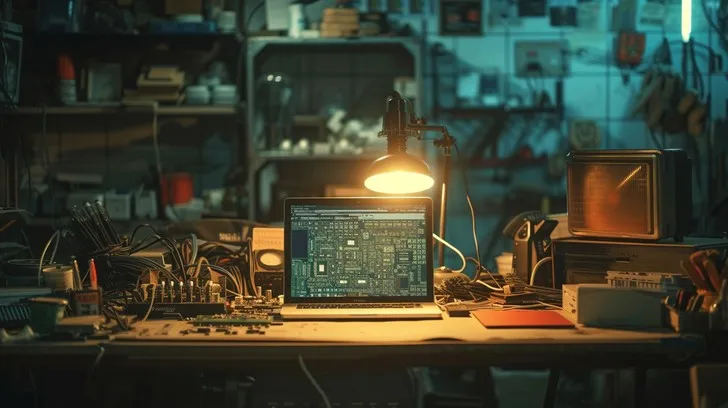
Photo: dark workshop desk with warm LED task lamp glowing over electronics workbench at night, via images.stockcake.com
There's a moment every maker knows. It's 11 p.m., you're hunched over a breadboard trying to figure out why your ESP32 refuses to boot, and you notice you've been squinting so hard your face hurts. You look up. There it is: the enemy. A single ceiling bulb, six feet above your head, casting a shadow of your own hand directly onto the thing you're trying to solder.
In the US, we treat lighting like plumbing — something that came with the house and isn't our problem. In the Nordic countries, where winter daylight can be a four-hour rumor, lighting is treated as a design discipline. And the core lesson from Scandinavian workshops is simple: one big light is a design failure. You want many small ones.
We rebuilt the Finnputer test bench around this philosophy. Here's what changed, what it cost, and why your ceiling bulb is quietly sabotaging you.
The Problem With the Big Bulb
Overhead lighting fails makers for three reasons.
First, shadows. Any single point source directly above your work area turns your hands, your soldering iron, and your microscope arm into shadow puppets. You're literally working in your own silhouette.
Second, glare. That same bulb reflects off your monitor, your glossy multimeter screen, and any shiny PCB surface. Glare doesn't just annoy you — it makes you misread resistor color bands, which is how a 10kΩ becomes a 100Ω and becomes a small fire.
Third, mood. A single bright overhead light at night feels like an interrogation room. Your brain doesn't relax, your eyes don't adjust, and your 30-minute soldering session becomes a 15-minute one because you just want to leave the room.
Pools of Light: The Nordic Framework
Scandinavian lighting design — think of the way Danish and Finnish interiors layer lamps instead of relying on ceiling fixtures — rests on three ideas that translate perfectly to a maker desk:
1. Light the task, not the room. You need brilliant, focused, high-CRI light on your work surface, and almost nothing on your face. A good task lamp with a narrow beam does this.
2. Warmth where it matters, coolness where it counts. Ambient and bias lighting should be warm (2700K–3000K) so your evenings feel human. Task lighting can run cooler (4000K–5000K) for color accuracy when you're matching wires or inspecting solder joints.
3. Never look at a bare source. Every light should be diffused, shaded, or bounced. If you can see the LED directly, it's wrong.
The $40 Bench Rebuild
Here's the setup we landed on, roughly in order of impact:
The task pool ($18). A clamp-on gooseneck lamp with a high-CRI (90+) LED bulb, positioned to the side and slightly behind your working hand — same side as your dominant hand, angled so your body blocks it from hitting the monitor. This kills 90% of your shadow problem.
The bias light ($12). A 6.5-foot USB LED strip in warm white (2700K) stuck to the back of your monitor, facing the wall. This is the single biggest quality-of-life upgrade for anyone who codes at night. Bias lighting raises the ambient brightness behind the screen, which dramatically reduces eye strain and makes the monitor feel less like a portal in a dark room. It also happens to look extremely good on video calls, which is a bonus you'll pretend you didn't plan.
The fill light ($10). A second small warm lamp — we used a cheap puck light on a shelf — placed somewhere behind and to the side of you. Its only job is to soften the contrast between your bright task pool and the dark rest of the room. Your pupils will thank you every time you look up from the iron.
The kill switch ($0). The ceiling light goes off. This is non-negotiable. The moment we stopped using it, the whole setup made sense.
Build Notes for the LED Strip
A few practical tips if you go the strip route:
- Buy a strip with adhesive you can reposition (3M-style backing varies wildly; the cheap ones peel off painted walls in winter).
- USB-powered strips are the move — no wall wart, no cable management crisis, and you can plug them into your monitor's USB port so they turn off with your display. Automation for free.
- If your strip has a dimmer, set it to about 60%. Bias lighting should be noticeable, not dominant. If you can read a book by it, it's too bright.
- Keep bias lighting warm and task lighting neutral-to-cool. Mixing them up is the most common mistake we see, and it makes your desk look like a gas station bathroom.
The Results
Subjectively: late-night sessions got longer and less painful. We stopped getting the 10 p.m. eye-strain headache. Objectively: when we pointed a camera at the bench, the shadow coverage on the work area dropped from roughly 40% to under 10%.
But the real finding is philosophical. The Nordic approach treats your lighting as part of your tools — something you design, not something you inherit. Your soldering iron has a temperature setting. Your monitor has a brightness setting. Your ceiling bulb, it turns out, is the only tool in your shop with no settings at all.
Turn it off. Build your own light.