Buffering Like It's 1996: A Finnish Field Guide to Outlasting Your Own Impatience
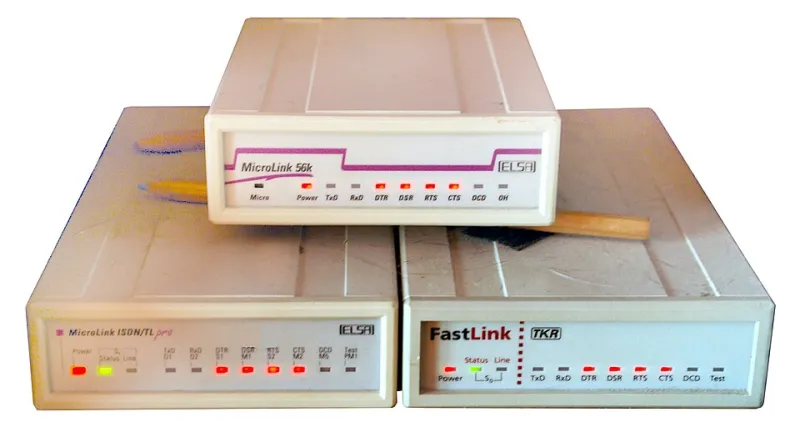
Photo: File:Elsa Modems IMGP0424.JPG: Johann H. Addicks - [email protected] derivative work: Pittigrilli, GFDL 1.2, via Wikimedia Commons
There's a specific sound that an entire generation of Finnish teenagers once knew by heart: the handshake screech of a dial-up modem negotiating with the world. To American ears it's a punchline from an AOL commercial. To Finns of a certain age, it was the sound of possibility arriving one kilobyte at a time.
And here's the uncomfortable part. That generation went on to build Nokia, Linux, and a chunk of the modern mobile internet — all before anyone in their country had what you'd call fast internet. Your 12ms ping to a game server in Virginia would have been, to 1996 Helsinki, a religious experience. So why does it feel unbearable?
The Slow Country That Outbuilt Everyone
It's worth remembering how weird Finland's situation was. A small, sparsely populated country at the edge of Europe, where running copper to a farmhouse outside Oulu could cost more than the farmhouse. Through the late nineties, most Finns were surfing the web at speeds that would make a modern smart thermostat file a complaint.
They built anyway. Text-based communities flourished. IRC — invented by a Finn, naturally — thrived precisely because it demanded so little bandwidth. Developers learned to read code, documentation, and each other's minds because downloading anything else took a coffee break. Necessity bred a culture of preparation: you thought before you clicked, because clicking had a cost.
Meanwhile, in the US, we got fast internet first and patience never. We skipped the training arc entirely. Which might explain why a 300ms load time now registers, neurologically, as a personal insult.
The Week We Broke Our Own Fiber
To test the theory, we recruited three American tinkerers to downshift their rigs for seven days. Not Luddite style — no smashing routers, no digital sainthood. Just deliberate friction, Finnish-flavored.
One volunteer throttled his home connection to a flat 3 Mbps, roughly a good dial-up multiplied by five. Another switched her development workflow to a ten-year-old ThinkPad running a lightweight distro. The third disabled every notification on every device and committed to checking email twice a day, at set times, like a person who receives mail.
The results were messier and more interesting than anyone expected.
The throttled volunteer reported genuine withdrawal for roughly 48 hours — the phantom urge to alt-tab to YouTube mid-task, like a tongue probing a missing tooth. By day four, something shifted. "I stopped context-switching because switching got expensive," he told us. "Turns out I didn't miss the internet. I missed the flinching."
The ThinkPad tinkerer discovered her fancy machine had been an accomplice. On old hardware, compile times that took four seconds now took forty, so she stopped treating compilation as dead time and started reading the code she was about to merge. Her bug rate, by her own admission, dropped. "Slowness made me read," she said. "Speed made me skim, then regret."
The notification abstinence volunteer lasted the full week but described the first three days as "a fire alarm only I could hear." By day seven, she'd finished a personal project that had been 80% complete since 2022 — a sentence every tinkerer will recognize as tragic.
Lag as a Feature, Not a Bug
There's a concept in Finnish culture called sisu — a stubborn, unglamorous perseverance in the face of difficulty. The dial-up era accidentally industrialized it. When every page load was a negotiation, you developed the capacity to sit with a delay without panicking. That capacity, it turns out, is the same muscle as deep focus. The waiting room and the workbench train the same skill.
Modern latency has done the opposite. We've optimized every microsecond of load time and, in doing so, removed every natural pause where a thought could finish forming. The result isn't productivity. It's a permanent state of interrupted beginning.
This isn't a call to smash your router. Fiber is wonderful. Fast is fine. The argument is narrower: if your patience atrophied because everything got fast, you can retrain it by deliberately making some things slow again.
Three Exercises for the Latency-Starved
The Throttle Ritual. Once a week, cap your connection to something genuinely painful — a few megabits, or use your OS's traffic shaping tools if you're the tinkering type. Do one focused task in that window. The goal isn't suffering; it's noticing how often you flee the task for the tab.
The Compile Read. Whatever your longest automated step is — a build, a render, a test suite — ban yourself from switching windows during it. Read your own diff instead. Old hardware enforced this for free; you'll have to do it manually.
The Batch. Check email and messages at two fixed times a day, and tell people you're doing it. The Finns didn't answer the modem's call every time it squealed either. Asynchronous is a lifestyle, not a setting.
The Ping You Can't Fix
Your 12ms will always feel slow, because the metric that matters was never milliseconds — it's whether a delay interrupts a thought or completes one. Finland built a world-class tech culture in the gaps between page loads. The gaps are still available. They're just no longer installed by default.
You'll have to build them yourself. Slowly, ideally.