Five Cheap Soldering Irons Enter. One Corroded Finnish Relic Decides Their Fate.
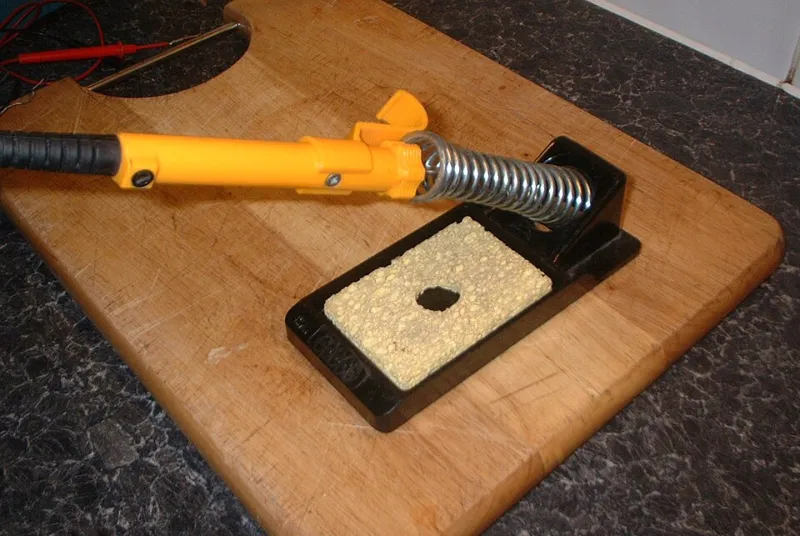
Photo: Bgrimer, CC BY-SA 3.0, via Wikimedia Commons
Every hobbyist eventually faces the same bench-side question: do I buy the $25 iron that came in a starter kit shaped like a ray gun, or do I mortgage a kidney for a proper station? The honest answer sits somewhere in between, which is why we spent three weekends and $243.87 (tax included, sadly) torturing five budget irons on the most hostile test board we could find.
The Victim: One Salty Nokia-Era Board
Our test subject came from a corroded Finnish-made industrial control unit purchased at an estate sale for less than the price of a sandwich. Decades in a humid basement gave its PCB a crust of green oxidation that would make a naval engineer nervous. Repairing it demands everything a beginner board does not: desoldering crusty joints, re-tinning lifted pads, and working around components that flake off if you sneeze.
Each iron had to: (1) solder a fresh 22-gauge joint, (2) desolder a corroded 3-pin connector, (3) recover a lifted pad with minimal drama, and (4) survive a 30-minute continuous session without wandering off its set temperature. We logged tip temps with a thermocouple every 15 seconds. Yes, we made charts. No, you can't escape the charts.
The Contenders
The $22 Pencil Special. Fixed-wattage unregulated iron. Think of it as a candle with a power cord. Cold joints on the big connector pads took 40 seconds of leaning, and its idle temp swung nearly 90°C over our 30-minute run. It soldered. Eventually. With prayer.
The $35 Adjustable Wand. A dial, a heating element, and optimism. Better than the pencil — it cleared the desoldering task — but the dial reads vibes, not degrees. We measured a 60°C gap between the dial's promise and the tip's truth.
The $48 Station with a Digital Readout. Here the plots get interesting: recovery from a cold connector took under four seconds, and total drift over 30 minutes was a respectable 12°C. The stock tip was mushy, but it takes C210-style cartridges, which is a genuine superpower at this price.
The $55 75-Watt Import Station. Raw wattage, zero finesse. Heats like a sauna in July, but the temperature loop overshoots by 30°C on every setpoint change. Great for heavy terminals, mildly terrifying for SMD work. Our test board's solder mask bears the scars to prove it.
The $59 Cartridge Station. The darling of the hobbyist forums, and for once, the forums are right. Sub-second recovery, drift under 8°C, and a tip ecosystem that means you'll never outgrow it. The stand is wobbly and the manual reads like it was translated by a raccoon, but the iron itself is the real deal.
Ergonomics, or: Whose Hand Hurt Least
After four hours of soldering, our test lead ranked grip comfort: the cartridge station won by a landslide (a pencil-thin, well-balanced handle), followed by the digital readout station. The 75-watt brute felt like holding a flashlight full of soup. The $22 pencil developed a hot spot near the grip that we can only describe as "educational."
The Verdict
If you're building your first bench: buy the $59 cartridge station and skip everything cheaper. The $14 you save on the $48 option buys you worse tips, slower recovery, and a future upgrade you'll regret not making now. If your budget is truly $25, buy the adjustable wand as a temporary guest, not a citizen, and start a savings jar labeled "cartridges."
And the corroded Finnish relic? Four of the five irons contributed to its revival, and the board now blinks a small green LED in our office like a tiny, stubborn heartbeat. Sisu, in component form.
Temperature stability ranking (best to worst): Cartridge station → Digital readout station → Adjustable wand → 75-watt brute → Pencil special.
Buy this if: you want to actually enjoy soldering. Skip this if: you enjoy suffering and call it "building character.**