Assembled by You, Glitched by You, Loved Anyway: The Firmware Behind the Furniture Effect
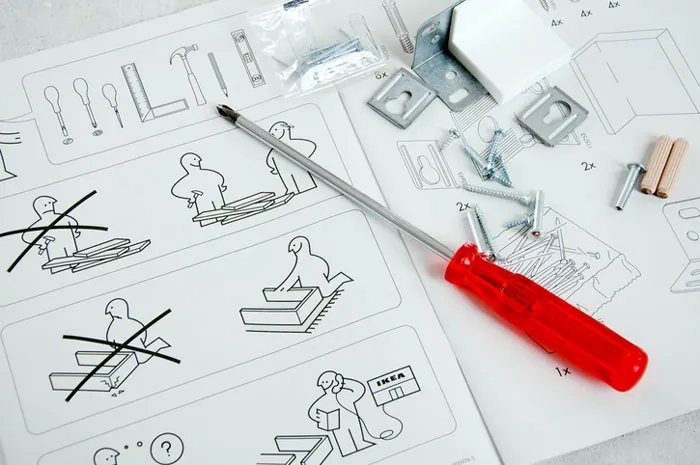
Photo: person assembling IKEA furniture at home with hex key and instruction manual, cozy apartment, via t.rmncdn.com
There's a cardboard box in a closet in Espoo, Finland, that contains the most valuable bookcase in the world. Not because of what it's made of — it's particleboard and a hex key's worth of dignity — but because a behavioral economist once used furniture exactly like it to prove something uncomfortable about human brains: we love things more when we suffer for them.
Researchers Michael Norton, Daniel Mochon, and Dan Ariely demonstrated this in 2012. People who assembled an IKEA storage box themselves valued it far higher than people who merely looked at an identical, pre-built one. The researchers named it the IKEA Effect: the moment your own labor touches a thing, its perceived value inflates. Even partially finished projects — the famous condition was that the experimenter had to let the builder finish, because interrupting the assembly killed the effect entirely.
Now here's the uncomfortable part for those of us with a ~/projects directory full of good intentions: the effect applies to unfinished work, too. And nowhere is that more visible than in software.
Your Homelab Is a LACK Shelf With Better Uptime
Consider the self-hosted homelab dashboard. You can buy — well, subscribe to — a polished SaaS product that monitors your servers, your smart plugs, and your espresso machine's firmware updates. It works. It has a support team. It has a logo designed by someone with a degree in logo design.
Or you can spend eleven weekends gluing together Grafana, a Raspberry Pi 4, a self-signed certificate that your own browser begs you not to trust, and a Python script that breaks every time daylight saving time changes.
Ask anyone with a homelab which one they'd defend in a bar fight.
"My dashboard is objectively worse than the commercial alternative," admits Marcus, a sysadmin in Ohio who asked us to use only his first name because his employer also sells monitoring software. "It goes down when I sneeze near the UPS. But when it works, it works because I made it work. That feeling is not purchasable."
This is the IKEA Effect with firmware. The Allen wrench is a text editor. The leftover screws are merge conflicts. The instruction manual with the wordless diagrams is — well, it's the documentation you didn't write, but that's a different article.
We Talked to the Defectors
The pattern shows up everywhere once you look. We heard from hobbyist programmers who abandoned polished products for hand-rolled alternatives that, by every measurable standard, are worse.
A developer in Portland replaced Notion with a folder of Markdown files and a shell script named brain.sh. "I lost full-text search for three months," she told us. "I gained the ability to know exactly why my notes app works. I can read all of it. It's 200 lines. When it breaks at 2 a.m., I fix it in ten minutes instead of filing a support ticket into the void."
Another reader self-hosts his family's photo library on a repurposed mini PC in a closet that gets uncomfortably warm in July. "Google Photos was better," he said, cheerfully. "Better search, better everything. But my kids' baby photos live on hardware I chose, in my house, on a drive I can physically hold. Try putting a price on that." (We tried. He wouldn't take it.)
Notice what's happening in these quotes. Nobody claims their creation is superior. They claim it's theirs. The value isn't in the artifact — it's in the authorship. Nordic design has a cousin concept here: the idea that an object earns its place in your life by being needed, not merely wanted. A janky self-hosted tool is needed by exactly one person, and that person is you, and that turns out to be enough.
The Dark Side: Romanticized Procrastination
But let's not turn this into a pep rally. The same psychology that makes your hand-patched fork feel precious also keeps you building a bespoke static site generator instead of, you know, writing the blog posts.
The IKEA Effect has a shadow self. If labor inflates value, then the promise of labor inflates it even more, and the README.md that says "TODO: everything" becomes a monument to your identity as a Builder of Things rather than a finisher of them. There's a fine line between "I built my own tools" and "building tools is how I avoid the actual work." Ask me how I know. Don't. Actually, the answer is the custom task manager I wrote in 2021 that I use to track the development of the task manager.
So here's the sidebar you actually need — a field guide to when DIY is real and when it's procrastination wearing a toolbelt.
Build it yourself when:
- You'll touch it often. Daily-use tools reward deep understanding. Your notes app, your dashboard, your backup scripts — these are worth owning.
- The failure mode is learning. Even a broken homelab teaches you networking, storage, and patience. The tuition is weekends, and the education compounds.
- Data ownership matters to you. Some things — photos, journals, financial records — carry value that no subscription's convenience should outweigh.
- The scope is small. If your tool is under a few hundred lines, maintenance is a hobby. Above that, it's a second job with no salary.
Buy (or just use) it when:
- The task is commodity. Nobody needs a self-built password manager. Use the audited one. Please.
- Security is load-bearing. Rolling your own crypto or auth is how you end up as a postmortem.
- You're building it to avoid something else. If the real project scares you, the dashboard is a hiding place with RGB lighting.
- You wouldn't maintain it while sick. If the thought of debugging it with a fever fills you with dread rather than mild annoyance, the IKEA Effect has you.
The Finnish Punchline
There's a reason this site keeps coming back to the assembly metaphor. In Finland, where I'm told the winters give you a lot of indoor time, there's less cultural shame in making something modest and imperfect for yourself. The sauna you built from a kit is not competing with a spa. It's yours, it's warm, and you know where every board came from.
Your half-finished open-source project is the same object in a different material. It will probably never have users. It might never have a version 1.0. But it has your fingerprints in every commit, and according to a decade of behavioral research, that's exactly why it feels better than anything you could buy.
Just — at some point — finish the box. The effect doesn't survive an interrupted build.