The $40 Farm-Auction Oscilloscope Was 'Untested.' Reader, It Was a Personality Test.
The auction was in a farm building outside Ames, Iowa, and the air smelled like diesel, dust, and someone's decision to sell everything. Between a pallet of fence posts and a box of mystery cables sat a gray oscilloscope with a handwritten card: UNTESTED. The bidding started at $10. I paid $40. This is not a financial advice column. This is a field report.
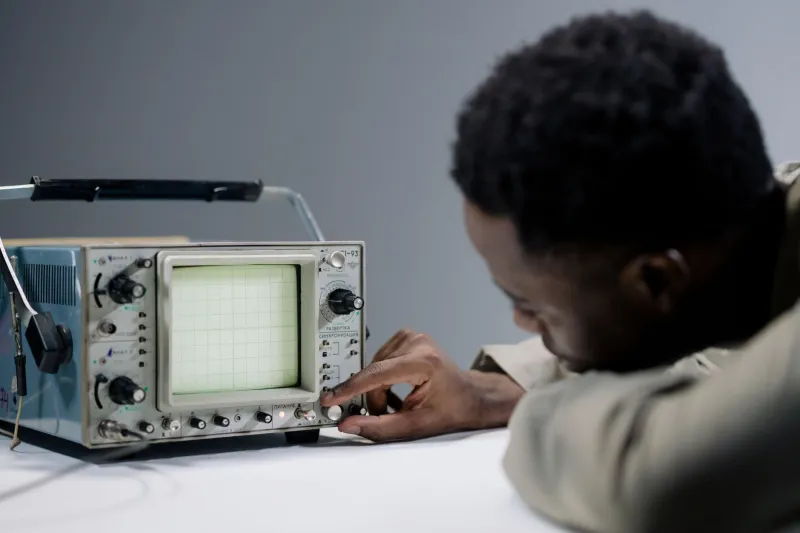
The scope was a Hitachi V-212, or close enough to one that the badge mattered less than the dust. It had two channels, a CRT, and a power cord that looked like it had been chewed by a goat with unresolved feelings. The seller said he had not plugged it in. That was the entire provenance. Untested. A word that sounds honest until you realize it is also a legal shrug.
What 'untested' actually means
Untested does not mean broken. It does not mean working. It means the seller has declined to participate in the question. Sometimes that is because they do not have a power outlet. Sometimes it is because they plugged it in, heard a pop, and decided to let the next person own the story.
The correct response is not hope. The correct response is verification. A new $400 scope arrives with a calibration certificate and a warranty. A $40 farm-auction scope arrives with a smell and a mystery. You are not buying a tool. You are buying an investigation.
The first ten minutes are about safety, not romance
Do not plug it into the wall and stand back like a proud parent. Open it first. Look for cracked capacitors, scorched resistors, mouse nests, and the kind of dust that has become a structural material. Check the fuse. Check the power cord. Check the CRT neck for cracks. If the inside looks like a fire waiting for a permission slip, stop.
A dim-bulb tester is a good friend here. If you do not have one, at least use a power strip with a switch and keep your hand near it. Do not connect the scope to expensive gear until you know it is not going to send a surprise voltage into your Arduino, your audio interface, or your confidence.
The fan on mine sounded like a Cessna at idle. That is not a failure. That is a vintage feature. But it did tell me the bearings were tired. I noted it and moved on. Cosmetics and noise are not the same as electrical danger.
The checks that matter
First: does it power on without smoke? This is a low bar, but it is the bar that matters most. Second: does the CRT produce a trace? If the screen stays dark, you may have a high-voltage problem, and that is not a hobby for a Tuesday night unless you are very sure of your limits.
Third: feed it a known signal. A 1 kHz square wave from a function generator is ideal. If you do not have one, an Arduino can produce a square wave, and a battery and a resistor can produce a DC level. The point is not precision. The point is response. Does the trace move when you change the vertical scale? Does the timebase change the shape? Do both channels behave the same way?
Fourth: check the probes. A bad probe can make a good scope look guilty. Fifth: look at the calibration sticker. A sticker from 1998 is not a promise. It is a historical document. It tells you someone once cared. It does not tell you the scope is accurate today.
The checks that do not matter
Scratches do not matter. A missing manual does not matter. The fact that the scope smells like a basement does not matter, although it may matter to your partner. What matters is whether the instrument can do the job you need it to do, within the limits you understand.
This is the part that new gear can quietly steal from you. A new scope says: trust me. A vintage scope says: verify me. The second sentence is more useful for a hobbyist. It forces you to learn what the controls do, what the trace means, and where the instrument stops being reliable. You do not get that from a calibration certificate. You get it from a 1 kHz square wave and a growing sense of humility.
Trust is a procedure, not a feeling
The scope now lives on my bench. It is not calibrated to a laboratory standard. It is good enough for audio, Arduino, and the kind of low-frequency troubleshooting that makes up most of my hobby. I know its limits because I tested them. That knowledge is worth more than the $40.
Would I trust it to measure a precision reference? No. Would I trust it to tell me whether a signal is present, whether a power rail is roughly correct, and whether my circuit is doing something deeply weird? Yes. That is not a contradiction. That is a scope with a job description.
The farm auction taught me something that a new $400 instrument would have hidden: verification is part of the hobby. The moment you open the case, check the fuse, and feed it a signal, you stop being a customer and start being an operator. The scope is not a toaster. It is a measuring instrument, and measuring instruments deserve suspicion until they earn trust.
What we would do differently
Bring a multimeter to the auction. Bring a power strip. Bring a flashlight. Do not bid on anything with a cracked CRT unless you enjoy decorative weight. Ask the seller if there is a return policy, knowing there is not. And remember that untested is not a discount. It is a transfer of risk.
But I would do it again. The scope works. The fan still sounds like a small aircraft. The trace is sharp enough to be useful and dim enough to be honest. And every time I turn it on, I remember the cardboard sign and the $40 and the lesson: trust is not something you buy. It is something you verify, one square wave at a time.