The Branch Audit: What Your Library Card Actually Entitles You To
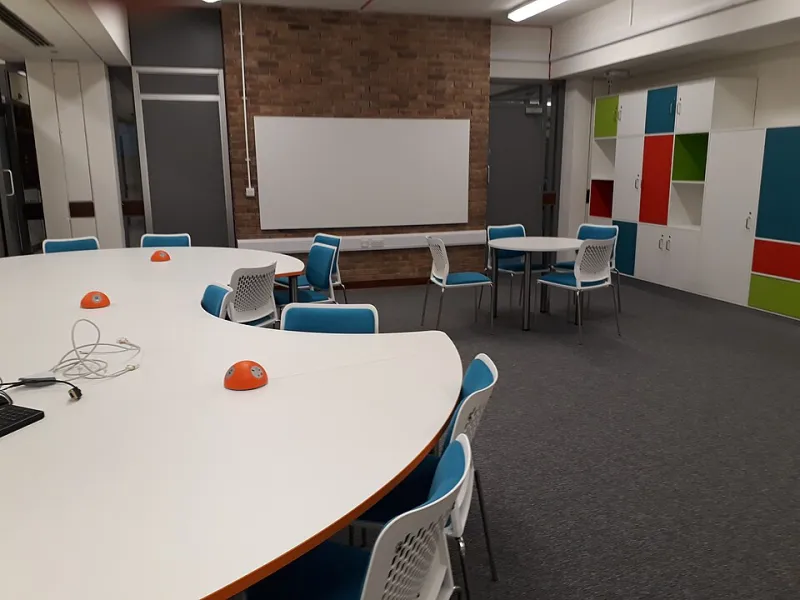
Photo: Mvolz, CC0, via Wikimedia Commons
In Finland there's a principle called jokamiehenoikeus — everyman's rights — that grants anyone the freedom to walk the forest, forage berries, and cross private land with care. It is a stunning idea: the good stuff is held in common, and access is a matter of conduct rather than cash.
It does not, unfortunately, cover drill presses.
But the American public library has spent the last decade quietly building something close to it. 3D printers. Laser cutters. Sewing machines. Podcast booths. Tool-lending catalogs. Repair manuals behind paywalls everywhere else. All of it funded by everyone, open to everyone, entered on foot with a card.
The bench you don't have to maintain
Your garage bench has a mystery stain, a spider who pays rent in silence, a vise bolted through a shelf that was never meant to hold it, and lighting that turns every solder joint into a rumor.
A library bench has level surfaces, good light, outlets that work, a copier nine feet away, and — this is the part nobody mentions — a librarian who knows how to find the service manual for a 2009 dryer. It also has a closing time, which is a feature, not a bug: it prevents the three-hour 'while I'm in here' spiral that eats your Saturday.
What's actually out there
Availability varies wildly, and that's the entire reason to audit rather than assume.
3D printing is now common enough to be boring. Usually PLA only, usually free or a few cents per gram, usually with a mandatory orientation and a cap on print time — often two to four hours, which rules out the helmet project you had planned.
Laser cutters and vinyl cutters cluster at larger central branches or in counties with a dedicated maker budget.
Sewing machines, embroidery rigs, button makers, and audio or video studios are more widespread than hobbyists realize, often attached to teen or adult services.
Tool lending is the sleeper. Berkeley's Tool Lending Library has been running since 1979; systems in Oakland, Chicago, Portland, Denver, and dozens of smaller cities lend drills, ladders, saws, and occasionally telescopes and cake pans. You borrow a rotary hammer for a weekend and return it. Nobody asks what you built.
Repair manuals are the most underused thing in the building. ChiltonLibrary, Haynes, Auto Repair Source, Consumer Reports, and various small-engine databases are typical subscriptions. Your card gets you into all of them from the parking lot.
Soldering stations exist, but they are rare and usually tied to a scheduled program rather than a walk-in bench. Ask directly; 'we have a maker space' can mean anything from a laser cutter to a box of LEGO.
Ask better questions than 'do you have a 3D printer?'
Yes-or-no gets you nothing. Try this script on the phone, before you drive:
Which printer model, and what material? What's the build volume? Cost per gram? Is there a job length cap, and does the clock include queue time? Do you slice, or do I bring a 3MF? May I bring my own filament? Is orientation required, and when does it run? Is the equipment staffed-only on weekends? How far out is the reservation queue? Do you have a soldering iron, heat gun, or multimeter, and can I use it unsupervised? Is there a tool-lending catalog? Can I book a study room with outlets for two hours?
The answers tell you more about a branch than any website. A branch with one printer and a responsive librarian beats a flagship lab with a three-week wait and a form that requires a notary.
What to bring, and what to leave home
Bring your own consumables where allowed — a spool of PLA, solder, wire, thread, a USB stick with your files in three formats because you never know, calipers, earbuds, a short power strip, a small towel, and a notebook for the branch's quirks. Leave the resin printer at home; ventilation is a hard constraint, not a suggestion. Leave your own power tools unless you've been invited. Never start a three-hour print at 4:55 p.m.
The branch scorecard
Score each branch out of twenty. It takes four minutes and settles arguments.
| Criterion | 0 | 1 | 2 |
|---|---|---|---|
| Machine inventory | none | one machine | two or more, documented |
| Cost transparency | unclear | on request | published |
| Orientation | none offered | quarterly | monthly or on demand |
| Hours that fit your life | closings only | evenings | evenings plus weekends |
| Staff competence | shrug | knows the machine | knows the machine and the manual |
| Bench quality | folding table | table with outlets | real bench, real light |
| Tool lending | no | limited | cataloged and circulating |
| Repair databases | no | one | several |
| Access | car only | bus | bus plus parking |
| Noise and crowding | shouting | mixed | quiet |
Fourteen or above and you have a workshop. Below eight, you have a reading room with a printer in the corner, which is still a fine thing to have.
The courtesy clause
Everyman's rights work because everyone maintains the common resource. Same deal here. Clean the bed, cancel the reservation you won't use, don't camp on the machine, don't hand a staff member a support-riddled STL and a hopeful expression, and don't expect free filament forever. Library staff are not your shop teacher. They are, however, often the only person in your county who knows what a watt is.
The Finnish verdict
Before you buy a four-hundred-dollar bench drill, spend one Saturday auditing three branches within twenty minutes of your house. Buy only what the library genuinely cannot give you: privacy, mess, and midnight hours. Everything else is already on the shelf with your name on it, and the late fee on a torque wrench is zero.